English in Academic and Professional Contexts
Brno, 21–22 January 2026
Dear EAPC 2026 Conference participants,
we would like to invite you to submit your conference papers. Below this announcement, you will find a template with detailed formatting guidelines. We kindly ask you to use this template when preparing your manuscript.
If you wish to have your article published in the conference proceedings, please submit the Word document to eapc26@fekt.vut.cz no later than
31 March 2026, which is the submission deadline.
All submitted papers will undergo a blind peer-review process. Accepted papers will be published in the official conference proceedings.
Thank you for your cooperation.
Finally, as mentioned in the closing speech, a new email address has been established to facilitate communication and mainly easier file sharing. Please do not be alarmed if you receive an email from EAPC.BUT@gmail.com — it is not spam, it is us 🙂
The template:
EAPC-2026---Proceedings-Paper---Template.docx
With kind regards,
The EAPC 2026 Organizing Committee
To say that English has become an integral part of professional and academic contexts is as much of a cliché as it is an understatement. Let us then dig beyond these simplifications and discuss the many fascinating ways in which this language shapes the academia and professional world while being simultaneously shaped by its users of various backgrounds as they go about their daily business in these spheres.
Key themes for the papers and posters in the individual sections include:
- new as well as well-established genres
- intercultural communication
- code-mixing and code-switching
- pedagogical implications and best practices
and many more. See our topic areas for further information.
We are honoured to announce that our distinguished colleague PhDr. Thomas Donaldson Sparling, B.A. (Masaryk University) has confirmed to be the keynote speaker at the conference.
Deadline for abstracts: 1st NOVEMBER 2025
Dear Conference Participants,
We are pleased to share practical information regarding the conference venue, parking, and nearby dining options.
📍 Conference Venue
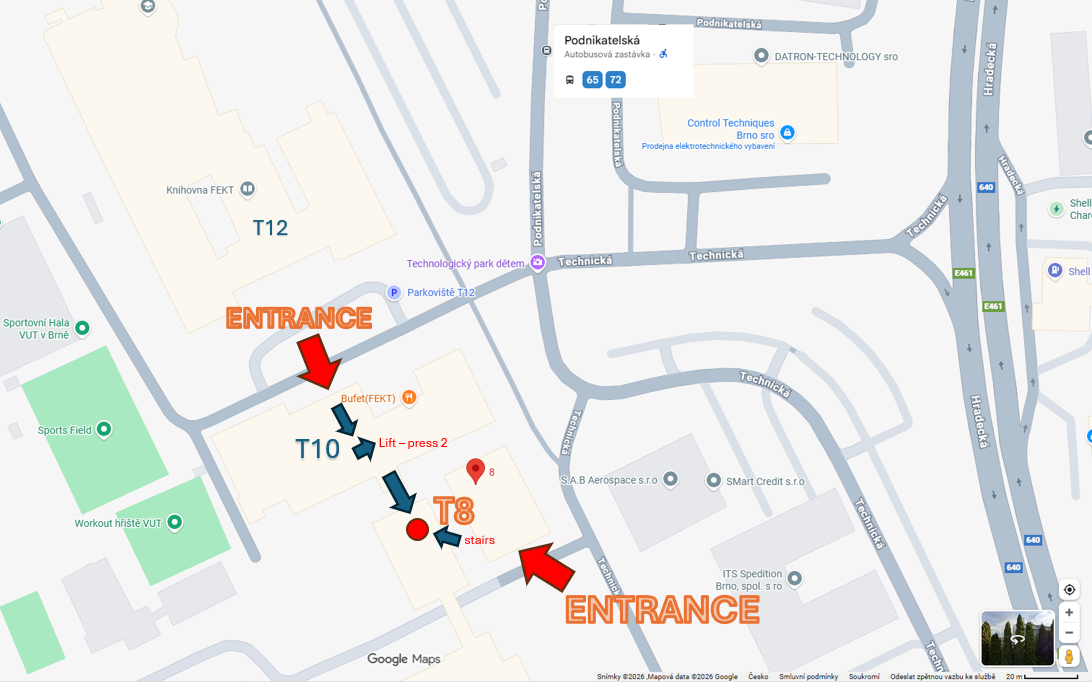
The conference will take place in Rooms 2.25, 2.35, and 21.5 at Technická 8 (T8), located on the first floor (marked as 2, as the ground floor is marked 1).
Directional signs will be placed throughout the buildings, so you may simply follow them. The description below is provided to give you an overview of the two main access routes:
Option 1: Entrance via T8 Building
- Enter the T8 building and proceed through the lobby.
- Walk diagonally to the left and take the stairs located just before the buffet.
- The lecture rooms are located along the corridor upstairs.
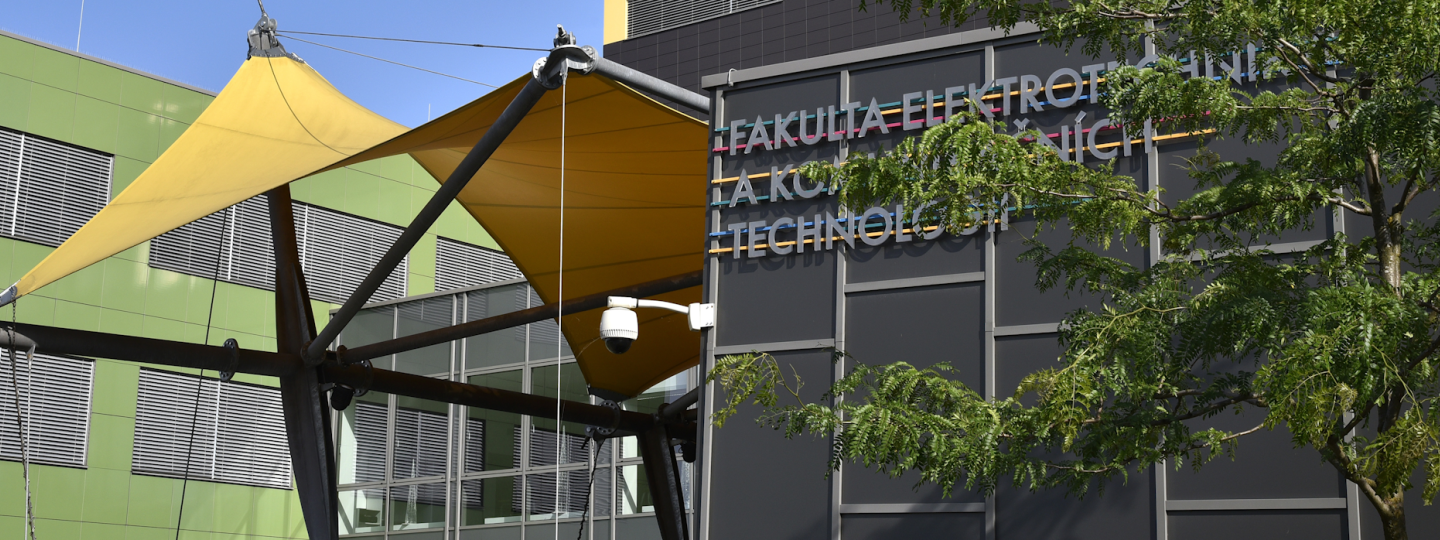
Option 2: Entrance via T10 Building (yellow awning)
- Enter the T10 building, walk straight past the reception, and continue through the glass door.
- From here, you have three options:
- Lift: Use one of the three lifts on the left, go to Floor 2, exit, turn left, pass through the glass door, and you will arrive.
- Lobby route: Walk straight to the end of the corridor, turn left into the main T8 lobby, turn right past the buffet, then right again to the stairs and go up one floor.
- Staircase: Turn right through the glass door to the staircase, go up one floor, exit at the door marked with a large “2,” turn left, and after approximately 10 meters enter through the glass door on your right.
🚗 Parking
Parking capacity is limited. Approximately 12 parking spaces are reserved for conference participants in the lower parking area between the T10 and T12 buildings, marked with an orange rope.
- Please use the lower parking gate from Technická Street.
- The upper gate is an exit only and opens automatically from the inside.
- Entry is controlled by a barrier. Use the intercom to contact the security guard (they have been informed about the conference; please note a possible language barrier).
- Alternatively, call +420 777 006 841, and someone will assist you on site.
🍽 Restaurants
As noted in the conference program, some meals will be provided. If you prefer a full lunch, the following nearby restaurants are recommended:
- Charlie's Park
Located along Technická Street toward the tram terminus (formerly Kanas). Offers excellent food and a pleasant atmosphere. À la carte prices are slightly above average, but daily set menus are reasonably priced. - Jean Paul's Restaurant
About five minutes further down the street near the lake. Features a multicultural menu and scenic lake views.
We look forward to welcoming you and wish you a pleasant stay at the conference.
Didactics of English for Specific Purposes (ESP)
The section is dedicated to exploring innovative approaches, tools, and methodologies that enhance the teaching and learning of ESP. Designed to offer a space for educators to exchange insights and best practices, it focuses on creating effective, learner-centred curricula tailored to the unique needs of students preparing for academic and professional settings. The topics will range from integrating technology and authentic materials to teaching discipline-specific vocabulary and fostering critical thinking skills.
In addition to providing teachers with practical strategies to improve learner engagement, autonomy, and performance, this section seeks to cultivate collaboration and dialogue between educators, researchers, and curriculum designers in the field of ESP. By addressing topics such as the use of digital tools and formative assessment strategies in teaching, participants will gain new perspectives on improving lesson effectiveness and impact. Whether exploring innovative course design or examining the role of feedback in language acquisition, it aims to provide actionable insights, enabling educators to refine their teaching practices while meeting the evolving demands of both students and their respective fields.
Topics:
- Innovative Approaches to Learning and Teaching ESP
- Psychological Aspects of SLA (motivation, learning strategies, foreign language anxiety, …)
- Integrating Technology in ESP Classrooms
- Assessing Foreign Language Skills and Knowledge
- Effective Approaches to Teaching ESP
- Designing Materials in Academic and Professional Contexts
- Designing ESP Courses in Higher Education
- Enhancing Learner Autonomy in Foreign Language Education
- Effective Feedback Strategies for ESP Students
- Adapting ESP Materials for Online and Blended Learning Environments
Linguistics with Special Focus on ESP
Ongoing research in English for Specific Purposes (ESP) is crucial for keeping pace with the evolving demands of professional communication. In the realm of linguistics, it offers practical and valuable insights into fundamental questions of linguistic theory. It challenges and refines our understanding of language variation, genre conventions, pragmatics, and discourse structures. At the same time, it provides real-world data that reflect the intricate relationships between language, context, and cognition in specialized domains.
The section offers an opportunity to explore how theoretical linguistics intersects with the practical applications of specialized language use, especially in relation to language structure, meaning, and discourse. The participants may address such issues as language variation, genre theory, pragmatics, and discourse analysis.
We welcome papers on ESP and Academic English including (but not limited to):
- ESP and Linguistic Variation
- Approaches to Genre in ESP
- Pragmatics and ESP: The Role of Context in Meaning Construction
- Discourse Analysis and the Structure of Specialized Communication
- Corpus Linguistics and ESP
- Conversation Analysis
Global Perspectives in Cultural Studies and Intercultural Communication
With the advent of globalization, the significance of cultural studies and intercultural communication has dramatically increased. Interactions among professionals from diverse linguistic and cultural backgrounds have become commonplace. Furthermore, these interactions — whether in business, research, or academia — are often influenced by local customs, specific cultural nuances, and, in many instances, recent historical and political contexts. Consequently, the ability to navigate these complex interactions has become a crucial component of English for Specific Purposes (ESP) and an essential skill for university graduates as well as seasoned specialists.
The topics may encompass, but are not limited to:
- Intercultural communication (specifics, challenges, teaching)
- Teaching cultural studies at university
- Cultural impact of technological innovations
- Transnationalization, migration, and cross-border issues/identities
- Multiculturalism
- Cultural minefields
- Changing world (habits, customs, borders)
Sign up!
Fill out the registration form
The deadline for registration and abstract submission is 1 November 2025, and the participants will be notified of acceptance by 1 December 2025.
Registration fee
Participants are expected to pay the registration fee by 1. 12. 2025.
For participants from the Czech Republic: CZK 2500 (including VAT)
For participants from abroad: EUR 100 (including VAT)
The price covers admission to the conference, a book of abstracts, conference materials, refreshments at coffee breaks and an informal reception. Registration fees are non-refundable.
Methods of payment:
Registration fees should be paid by bank transfer.
Bank payment information for CZK
Account holder:
Vysoké učení technické v Brně
Antonínská 548/1, 602 00 Brno-Veveří
Bank address:
Československá obchodní banka a.s.
Radlická 333/150
150 57 Praha 5
Account number: 111044161/0300
Variable symbol: 182503001
Payment identification: the participant’s name and surname and/or sending organization
IBAN: CZ04 0300 0000 0001 1104 4161
SWIFT Code: CEKOCZPP
Bank payment information for EUR
Account holder: Vysoké učení technické v Brně
Antonínská 548/1, 602 00 Brno-Veveří
Bank address: Československá obchodní banka a.s.
Radlická 333/150
150 57 Praha 5
Account number: 1017712113/0300
Variable symbol: 182503001
IBAN CZ24 0300 0000 0010 1771 2113
SWIFT Code CEKOCZPP
Billing details
Brno University of Technology
Faculty of Electrical Engineering and Communication
Department of Languages
Technická 10
616 00 Brno
IČ 00216305
DIČ CZ00216305
Click here to download the conference programme:
EAPC-2026-Conference-Programme.pdf
Book-of-Abstracts.pdf
The length of each presentation is scheduled for 20 minutes, followed by 10 minutes for discussion and questions. The workshops are expected to last 45 minutes.

Department of Foreign Languages
Technická 3058/10
616 00 Brno
Czech Republic
Web: www.ujaz.fekt.vut.cz
E-mail: eapc26@fekt.vut.cz